Characteristics of Learners on Assessment:
All learners are professional educators and classroom mathematics teachers at Rock Hill High School. This professional development (PD) session is not required, thus the learners are motivated to learn about the content through their voluntary sign up. The learners have experience both in attending PD and evaluating the efficacy of the sessions. Due to the nature of the learner and the content of the PD, the assessments will be staggered so part of the evaluation can take place after implementation in the performance context.
Assessments/Evaluations:
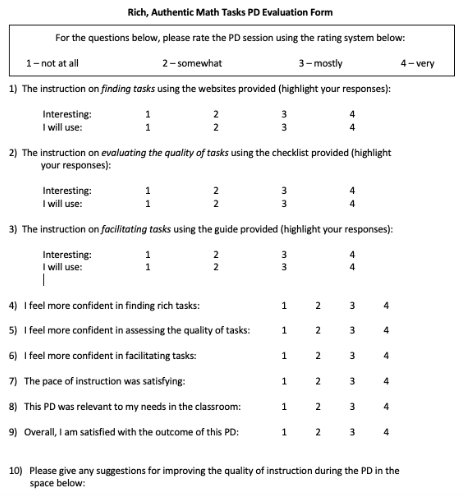
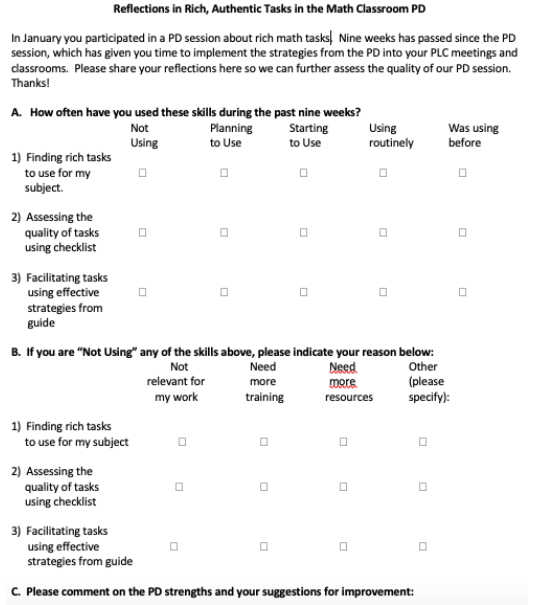
Two evaluations have been created – one to focus on evaluating the quality of the instruction and one to focus on the impact of the instruction. At the conclusion of the PD session, the learners will complete the first evaluation form, assessing both the instructional content and attitudes. After nine weeks, the learners will be asked to complete a second evaluation, assessing the impact of the instruction (in the performance context). This will give the learners enough time to apply the outcomes of the PD session in the performance context. Both of these assessments will be delivered over Canvas LMS so learners can complete and submit the document online (hard copies will also be available if needed).
The following form will be used at the end of the PD session to evaluate the immediate quality of the instruction:
The following form will be sent to the learners after nine weeks, to evaluate the impact of the instruction:
Evaluation Materials:
Evaluation materials include laptops, Canvas LMS, Microsoft Word, evaluation forms (online with hard copies if needed).
Evaluation Process Procedures (time, place, procedures, concerns, etc.):
The first evaluation form will take place at the conclusion of the PD session (approximately 4:45 on a Tuesday afternoon). This evaluation will take place directly following instruction, which includes having the learners practice by creating a product with their PLC groups. The second evaluation will take place nine weeks later.
The instruction takes place in a space that mirrors the performance context for the learners (a classroom at Rock Hill High School). The product production and session evaluation will both be completed in this space. The second evaluation will be dispensed online and thus may physically be taken anywhere they have internet access; however, the focus is on evaluating the outcomes in the performance context.
Procedures:
- Instruction – learners are provided with a rich task to attempt and provided with the goals of the PD session.
- Instruction – learners participate as the 3 outcomes are modeled by the instructor.
- Instruction – learners collaborate in PLC groups to find a task go through the process of evaluating its quality and determining methods of effective facilitation.
- Post Instruction Evaluation – learners complete the first evaluation form (evaluating instruction and attitudes) in the instructional context.
- Post Instruction Evaluation – after nine weeks, learners complete the second evaluation form (impact of instruction) in the performance context.
There are some potential concerns regarding the evaluations. For instance, since the instructor is a teacher colleague, some of the learners may feel uncomfortable giving critical feedback. This can be mitigated by making sure the learners understand that the evaluations are anonymous (not associated with a name). There is also a concern that the second evaluation (on classroom impact) may be harder to implement since it is given online and the learners may not be as motivated to complete it in a timely manner. This will require reminders and follow up to make sure all the learners participate.
References:
Dick, W., Carey, L., & Carey, J. O. (2015). The systematic design of instruction (Eighth edition). Boston: Pearson.
Krall, G. (2018). Necessary conditions: teaching secondary math with academic safety, quality tasks, and effective facilitation. Portland, ME: Stenhouse Publishers.
 Instructional Insights