Instructional Goal Statement:
The learners (math teachers at Rock Hill High school) will be able to work with subject area teams using their laptops to:
- Find one or more rich, authentic math tasks appropriate to their subject matter.
- Use a task quality checklist to assess the quality for at least one of the tasks found.
- Describe at least three elements of effective facilitation (norms, routines, etc.) for at least one of the tasks found.
Performance Objectives:
The following performance objectives have been written for the instructional goals above, making sure each performance objective includes the appropriate conditions (CN) for the performance of the skill, an observable behavior of the skill (B), and the criterion (CR) for judging acceptable performance of the skill. (Dick, Carey, & Carey, 2015, p. 132).
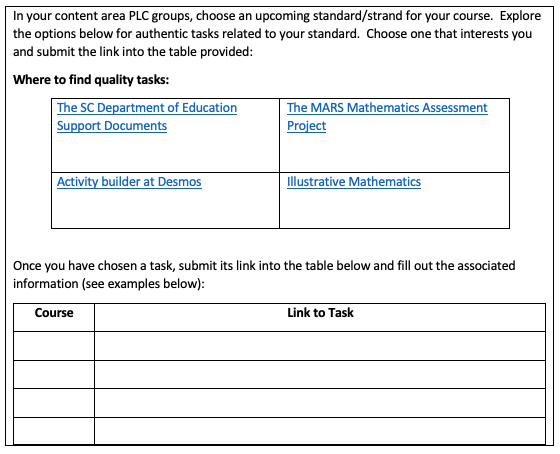
- Given a hyperlinked document with a list of websites (CN), the learners will select a rich, authentic math task for their content area to submit in an interactive Word document (B). At least one rich, authentic math task should be submitted per course (CR).
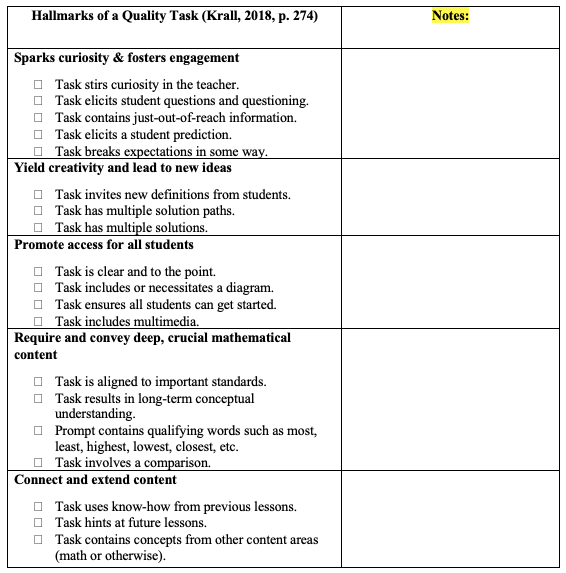
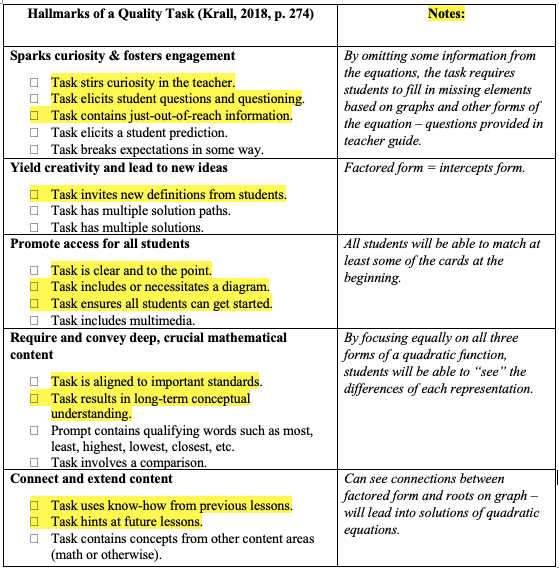
- Given an interactive task quality checklist (CN), the learners will complete the checklist within PLC groups (B). Learners in their PLC groups will cooperate with each other in discussion to assess the task (CR).
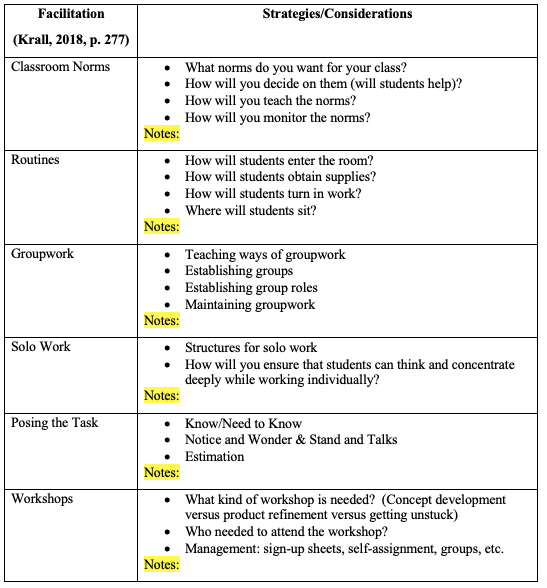
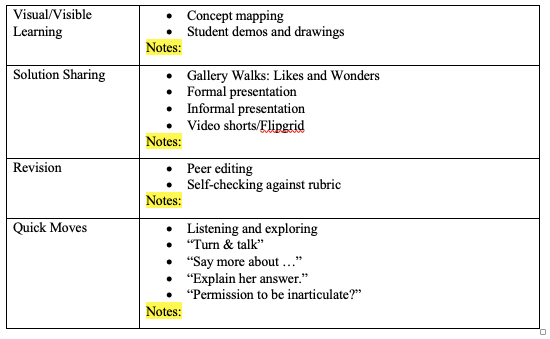
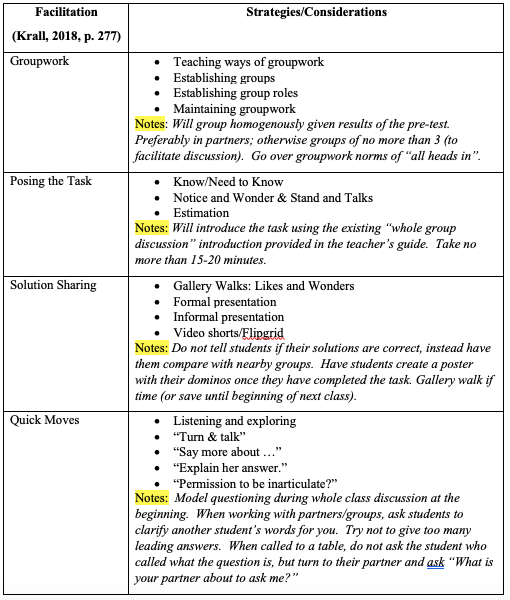
- Given an interactive effective facilitation guide (CN), learners will complete the guide within their PLC groups to identify effective facilitation techniques for the task (B). At least three effective facilitation techniques should be described (CR).
Sample Assessments for Each Objective:
The learners are a group of math teachers attending professional development so traditional test items are not appropriate to the goals. Thus, an instrument is created to first write directions to guide the learners’ activities and to evaluate the performances. (Dick et al, 2015, p. 148).
Assessment for Performance Objective 1: Learners will be provided with a hyperlinked document. They will work to interactively submit tasks. Criterion of at least one task submitted per course will be assessed through evidence of submission.
Assessment for Performance Objective 2: Learners will be provided with an interactive checklist to complete while discussing quality of task with PLC members. Criterion of discussion about quality of task will be assessed through evidence of checklist submission.
Assessment for Performance Objective 3: Learners will be provided with an interactive effective facilitation guide (example below) to complete while discussing facilitation techniques with PLC members. Criterion of at least three effective facilitation techniques of the task will be assessed through evidence of guide submission.
Instructional Sequence:
The instruction will begin with an introductory example of a short task to gain the attention of the learner (5 to 10 minutes). The learners will then be informed of the objectives of the PD session. The instructors will walk through the three goals with the learners, modeling with a chosen task as a way of providing learning guidance. This should take approximately 15 to 20 minutes. The remaining 30 to 40 minutes will have the learners working together in their subject area PLC groups to complete the performance objectives. Online submissions will be completed by the learners that can be assessed by the instructor to ensure the learners’ understandings of the objectives. After the session, learners should be able to transfer their skills to the performance context (their own subject area PLC meetings).
Pre-Instructional Activities:
To ensure successful instruction, the pre-instructional factors of motivating the learners, informing them of what they will learn, and stimulating recall of relevant skills and knowledge must be attended to (Dick et al, 2015, p.175). The short introductory task serves as a mental challenge to motivate the learners and provide relevancy to the objectives. The learners will be informed of the objectives before instruction, so that they can find it easier to focus on the essential content and determine the relevancy to their own classroom content. In terms of pre-requisite skills, a brief mention will be made concerning the skills (mainly basic computer literacy and the ability to engage in professional dialogue), but it will be followed by an acknowledgment that we will proceed on the assumption they can perform these skills.
Strategies for Teaching Each Objective:
All three objectives will be taught through modeling with an example task. As a whole group, we will first select a rich, authentic task from the sources provided. We will then, as a whole group, assess the task using the quality task checklist and though collegial discussion. An effort will be made to include some non-examples so learners can more easily differentiate between quality and non-quality. Finally, we will again as a whole group use the effective facilitation guide to identify at least three facilitation techniques to support classroom implementation of the task. After the modeling portion of instruction, the learners will break into their subject specific PLC groups to repeat the process in small groups for a relevant upcoming standard. The instructor will be available for feedback and assistance as needed.
Information and Example for Each Objective:
During instruction, the learners will proceed through a modeling lesson with the instructor. The standard for the instructional example will be graphing quadratic functions in various forms. As a whole group, we will explore some tasks, and then proceed through the objectives using the pre-selected task “Representing Quadratic Functions Graphically”.
Example for Performance Objective 1: After selecting the task, we will update the collaborative document with the information required.
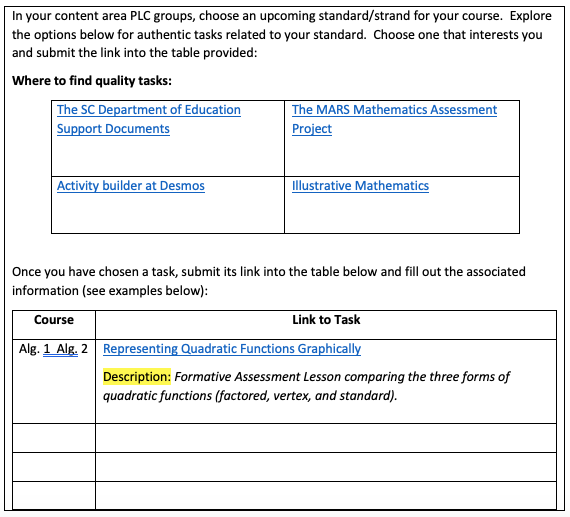
Example for Performance Objective 2: After we have submitted the task to the table, learners will then as a whole group discuss and fill out the quality task checklist for the task chosen, including any notes.
Example for Performance Objective 3: After completing the quality task checklist as a whole group, we will then choose at least three strategies from the effective facilitation guide and elaborate on their use with notes.
Practice and Feedback for Each Objective:
After whole group modeling of the process with the instructor, the learners will then break into their subject specific PLC groups and go through the process on their own, identifying a task for their content area, assessing its quality, and determining effective facilitation techniques. The instructor will be available for verbal feedback during this time. The instructor will use the rubrics above to assess the learners’ level of understanding.
Media Selections and Rationales for Delivery of Instruction:
The instruction will be facilitated by the instructor in a face-to-face classroom. The rationale for this being that it is the simplest method as all the learners are already required to be on campus. The instructional materials will include the three previous assessment documents to be delivered via the school’s learning management system, Canvas. The rationale for using Canvas to disseminate the documents is that it is free for the instructor and learners, and it can be used to embed cloud documents for collaboration (such as the first document where the learners will submit their tasks). The modeling portion of the lesson will be delivered using a ClearTouch panel with wifi capabilities. The group portion of the lesson will be performed by the learners using their laptops. All of these choices were made as they were free and/or pre-existing, and the materials being utilized imitate the materials the learners will have access to in the performance context.
Pre and Post-Tests:
As the learners are not being assessed via traditional test items, the post-test equates more to product production (a list of tasks, with notes on their quality and their facilitation). These will all be housed on Canvas LMS that all the learners have access to online. In terms of formative assessment during the lesson, this will be done informally through discussion and questioning as the process is modeled and when the learners are working in their PLC groups. Additionally, all learners are required to submit a reflection of the session per school guidelines. This data can also be used to formatively evaluate the session.
References
Dick, W., Carey, L., & Carey, J. O. (2015). The systematic design of instruction (8th ed.). Boston: Pearson.
Krall, G. (2018). Necessary conditions: teaching secondary math with academic safety, quality tasks, and effective facilitation. Portland, ME: Stenhouse Publishers.
 Instructional Insights