Badge Creation
I created a digital badge to use during exam review in my AP Statistics classes. I have several digital review modules on my course Canvas learning management system (LMS) page, and I decided to connect the modules to the 4 domains that are on the AP test. The design below shows my first badge, corresponding to the topic of “Data Analysis”:

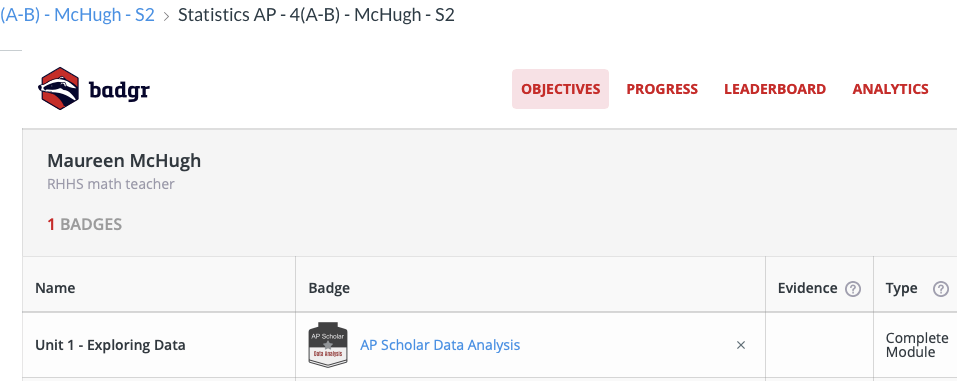
After creating the badge, I imported it into Badgr, and made myself an issuer. Canvas LMS has Badgr as a compatible app, so I was able to, within Canvas, set up the badge to be awarded at the completion of the review module (see screenshot below):
Overview of Badge Design
I used the following 11 criteria while designing my badge:
Users – The badges will be awarded to students in my AP Statistics classes as they complete modules within Canvas LMS. I have designed the first of four total badges that represent the 4 domains on the AP exam (Data Analysis, Sampling & Experiments, Probability, and Statistical Inference). As the students earn the badges, they can be confident that they are well prepared for the AP exam.
Criteria – To complete a badge, students must fully complete a module for the exam review. The modules consist of: watching videos and completing review notes, submitting answers to AP exam free response questions, and submitting a multiple choice quiz. The modules are set up to go in sequential order and unlock only when the previous step has been completed. Students may need to complete 2 modules before being awarded the badge (to correspond with mastery of the 4 domains).
Skills & Knowledge – The badges will correspond to the topics on the AP Statistics Exam. My design is for the first topic on the exam, data analysis. This includes displaying data and comparing data using different measures. Students will need to show mastery not only of the concepts, but proficiency in adequately answering old AP exam free response questions and AP style multiple choice questions.
Behaviors – The badge should encourage students to use the correct methods for answering AP exam questions (ie, using the correct terminology and answering “the AP way” for full credit) and to utilize good test taking strategies for multiple choice items. The badge should also encourage students to focus on the four domains as they prepare for the exam.
Evidence – The badge will be issued via our LMS, thus all evidence will be online. Within the modules they must complete, students will indicate they watched the videos (“mark as done”) before the next step in the module unlocks. The next step will require them to submit a free-response AP exam question. Once they have submitted, the next part will open, which is a multiple choice quiz. Students must make a minimum of a 50% on the quiz (which translates to a 3 on the AP exam) before the module is considered complete.
Value Proposition – I hope that as the students work through the modules, they find value in displaying their mastery of the certain domains on the exam. This should help build their confidence before the actual AP exam.
Endorsers – Through our LMS, the school acts as an endorser. My hope is to work with the AP teachers at other schools, so we can implement badges district wide, thus increasing recognition.
Channels – The exam review modules have already been created in our LMS, thus adding the badges fits well within the current system. Students will be made aware by the teacher of the badges at the beginning.
Awarded – Our LMS will award the badge automatically as the criteria within the modules are completed. The Badgr app has been integrated into our LMS for this purpose.
Learning Pathways – At the present, I have only created badges for the review modules at one level. However, I am interested in incorporating the badges earlier in the course, where students can earn a “novice” level badge. Then, after showing mastery of the topic during exam review, they can earn an “expert” level badge.
Resources – I used a free badge creator (https://badge.design) to create my badge. In my use for classroom implementation, this is sufficient. I will be able to create the 4 badges needed for the four domains with limited time spent. Using the Badgr app within Canvas LMS also allows for free dissemination of the badges.
Reflection
Overall, I found the experience of creating a digital badge fairly easy. The most important part to me was deciding what content would lend itself best to the badging process. Since I already had review modules created for the AP exam in our LMS, it made sense to attach badges to them to make it more motivating for the students.
Our school district has used badging as a way to mark professional development in the past. I do find it motivating to earn a badge so that whenever I have contact with others through our LMS, they can see my badges. Having a badge on display is a permanent way to display competency/achievement to others.
I think the most important take away from the process is to really make sure the badge is tied to something important. The “value proposition” idea. As I teach teenagers, motivation is often an issue in getting students to complete the work needed for a course. Badging is not something I would want to overuse, or make too easy, as it would lose meaning for the students. I think being very intentional about where and why to use badging is the most important aspect of its implementation.
I think I can incorporate digital badging into most of the course I teach. As a 1:1 district, all the students have laptops and we have an LMS, so blended learning and personalized learning pathways are being incorporated more and more. During times when I want the students to complete more online learning (through completing modules), I think using badges can help motivate the learners and are also easy to issue through our LMS.
One of the challenges I anticipate in digital badging using our LMS is in having the module completely created before the students use it (many times, teachers modify and add/take away parts as they teach). However, this will just mean having to go back and change the requirements for the badge to be issued. It will also require close work in PLCs to make sure the same opportunities for badging are being offered in all classes. I think a benefit to digital badging is in creating an incentive that is free and relatively easy to implement. It can be a way to help increase motivation and a source of pride for students.
 Instructional Insights