Instructional Analysis Context:
I will be conducting a one hour professional development (PD) session on how to find, assess the quality of, and implement rich, authentic math tasks in the secondary mathematics classroom. The learners consist of 13 high school math teachers at Rock Hill High School in Rock Hill, SC. This PD is designed to meet a teacher need for utilizing rich math tasks in the classroom. It aligns with stated school and district instructional goals for students. Twelve of the thirteen teachers have already received initial training in the research behind and benefit of using rich, authentic tasks in the classroom, so this session targets their concerns of: 1) How to find rich tasks, 2) How to assess the quality of such tasks, and 3) How to effectively implement rich tasks in the classroom.
The instruction will take place in a math classroom at Rock Hill High School. The classroom is wifi capable and all learners have access to personal laptop computers. An interactive ClearTouch panel is available as needed for delivering the instructor’s presentation. This site mirrors the performance context for the learners.
Rationale:
The mathematics department at Rock Hill High School has been participating in the MDC (Mathematics Design Collaborative) initiative from the Southern Regional Education Board for the past three years. A focus of MDC is using rich, authentic math tasks to promote student understanding of mathematical concepts. During the initial years, tasks have been provided to the department. Now, the impetus has shifted to sourcing and incorporating more tasks while teaching on the workshop model. Teachers have indicated a need for being able to find quality tasks for use in their discipline area. Additionally, teachers have indicated they do not feel entirely comfortable with assessing the quality of the tasks they find to know if it is a high quality task (accessible yet rigorous). Best practices for implementing said tasks has been another stated concern. This PD session would address the three concerns by having teachers work together in their subject area groups to find tasks, assess their quality, and design an appropriate method for classroom implementation. After this session, the teachers will be able to replicate the process in their subject area personal learning community (PLC) meetings going forward.
Description of Context:
Finding, Assessing, and Using rich, authentic tasks in the math classroom:
- Rich, authentic math tasks can be found at a variety of sites online (South Carolina Department of Education standards support documents, Illustrative Math, the MARS project, Desmos).
- Students engage in productive struggle rather than using predetermined steps to find an answer. (Mathematics Design Collaborative, 2019).
- Students build fluency with their procedural skills and deepen their mathematical reasoning and understanding. (Mathematics Design Collaborative, 2019).
- Enables students to understand math concepts and how to put them to use – learning that is often lost when individual procedural skills are the only focus of teaching. (Mathematics Design Collaborative, 2019).
- Hallmarks of a Quality Task: spark curiosity and foster engagement, yield creativity and lead to new ideas, promote access for all students, require and convey deep mathematical content, and connect and/or extend content. (Krall, 2018, p. 274).
- Effective Facilitation of Tasks: establishing, teaching, and reinforcing norms, establishing routines (groupwork and solo); posing the task; workshops; visual learning; solution sharing; revision; quick moves. (Krall, 2018, p. 277-278).
Description of Learners:
A survey sent to the learners gleaned the following information:
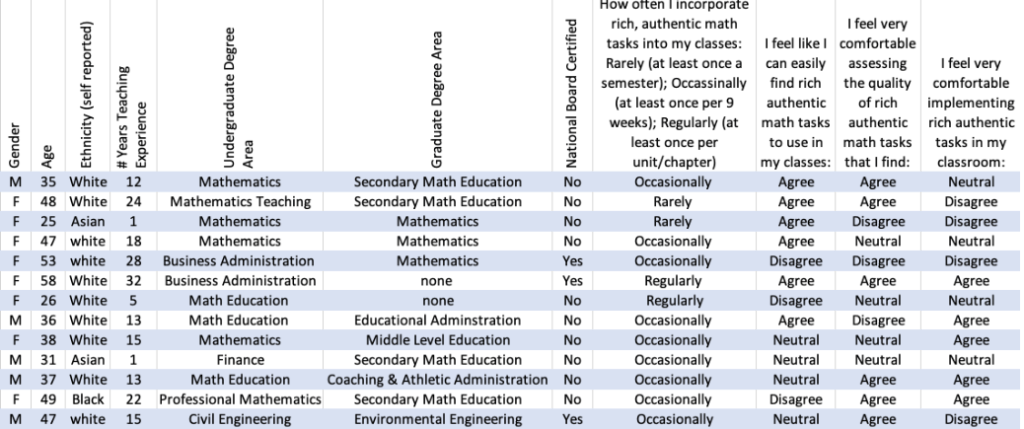
These answers showed that most participants are educated in mathematics education at the undergraduate and/or graduate level, with the two exceptions to this having become National Board Certified in Adolescent Mathematics. This means all participants can be expected to have had an academic exposure to mathematical teaching theory and pedagogy. Practical teaching experience varies from 1-32 years and is spread rather evenly amongst the specific subject area groups. The learners also indicated their comfort with finding, assessing the quality of, and implementing rich tasks in the classroom, which can be used to help group learners and provide supports. In addition to the results of this survey, workplace interviews indicated positive attitudes regarding the training. As this is an optional PD session, a high level of motivation is present since the learners are not required to attend if they do not desire to.
Performance Context of Learners and Its Implications for Instruction:
After the PD session, learners will have support from the same subject area group members with whom they worked during instruction (PLC subject groups). Learners will have the instructional context leader to turn to as a resource (as I am a teacher colleague). The instructional context, a classroom, is the same as the performance context. The tools available during instruction will be available to the learners in the performance context, including personal laptops, wifi, a list of websites from which to source tasks, copies of the checklist, and copies of the facilitation guide. Additionally, the learners do receive administrative support in the performance context, as the learners are provided with protected PLC meeting times weekly to work together. Because the performance context is very similar to the learning context, the skills should be easily transferred.
Instructional Goal Statement:
The math teachers at Rock Hill High school will be able to work with subject area teams using their laptops to:
- Find one or more rich, authentic math tasks appropriate to their subject matter.
- Use a task quality checklist to assess the quality for at least one of the tasks found.
- Describe at least three elements of effective facilitation (norms, routines, etc.) for at least one of the tasks found.
Goal Analysis:
Based upon the goal, learners will be able to do the following:
- Use laptops to search for rich, authentic math tasks using a provided list of websites
- Select a math task appropriate to their subject matter
- Complete the provided quality checklist to assess the quality of the task
- Complete the provided effective facilitation guide to identify at least three elements for effectively utilizing the task
- Discuss with colleagues
Subskill Analysis:
- Use laptops to search for rich, authentic math tasks using the provided list of websites
- Navigate to https://ed.sc.gov/instruction/standards-learning/mathematics/support-documents-and-resources/
- Navigate to illustrativemathematics.com
- Navigate to map.mathshell.org
- Navigate to teacher.desmos.com
- Select a math task appropriate to their subject matter
- Search by topic using search bars
- Select sample lessons by clicking to view
- Choose a task appropriate for their students based on content knowledge
- Complete the provided quality checklist to assess the quality of the task
- Given specific criteria under each of the following categories, determine if the task does the following:
- Spark curiosity and foster engagement
- Yield creativity and led to new ideas
- Promote access for all students
- Require and convey deep, crucial mathematical content
- Connect and extend content
- Complete the provided effective facilitation guide to identify at least three elements for effectively utilizing the task
- Using the task selected, determine at least three specific strategies for effective facilitation from the categories:
- Classroom Norms
- Routines
- Groupwork
- Solo Work
- Posing the Task
- Workshops
- Visual/Visible Learning
- Solution Sharing
- Revision
- Quick Moves
- Discuss with colleagues
- Engage in professional discussion of task with teachers who teach the same subject
- Describe any positive and negative aspects to the task’s quality
- Describe and positive and negative aspects to the task’s facilitation
Entry Behaviors Analysis:
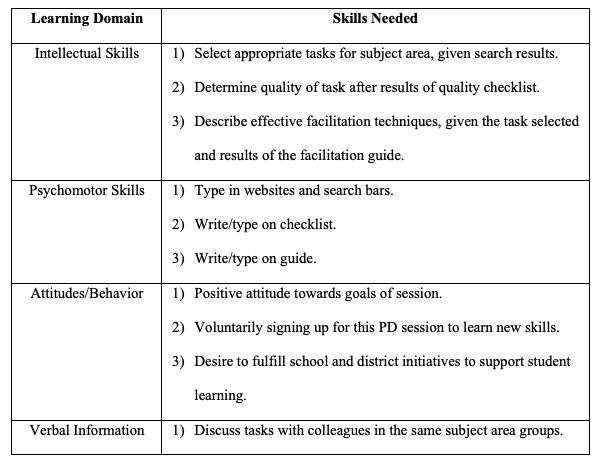
- Typing and navigating on the internet
- Using search bars and find command
- Filling out a checklist
- Filling out a guide
- Professional conduct during discussions
References:
Mathematics Design Collaborative: Engaging Students So They Get the Hows and Whys of Math. Retrieved (September 20, 2019) from https://www.sreb.org/mathematics
Krall, G. (2018). Necessary conditions: teaching secondary math with academic safety, quality tasks, and effective facilitation. Portland, ME: Stenhouse Publishers.
 Instructional Insights